
Amazon Scraping Guide 2026: Product Data, Prices, and Sellers

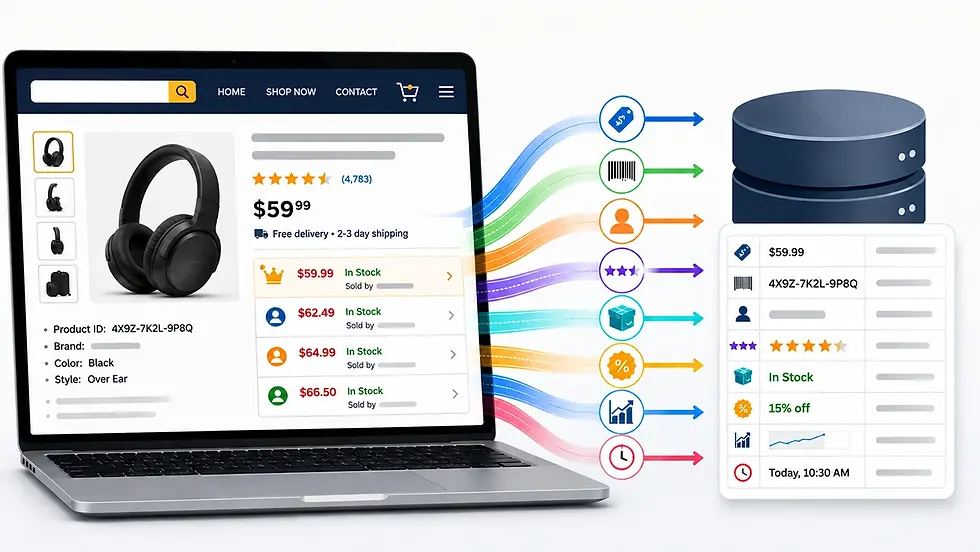
Amazon scraping is the practice of collecting publicly visible product, pricing, and seller data from Amazon's retail pages so a business can use it for competitive pricing, catalog intelligence, and market research. The data you can collect includes product and ASIN details, current prices and the competing seller offers behind the Buy Box, seller identities and ratings, product variations, reviews, Best Seller Rank, availability signals, and promotions. Getting a few pages once is straightforward. Getting accurate Amazon data continuously, across thousands or millions of products, is where most projects run into trouble. At Ficstar, we collect public pricing and product data from Amazon, eBay, Walmart.com, and other marketplaces for enterprise clients, and we process more than one billion product prices every month, so the practical realities in this guide come from doing this work every day.
This guide covers what data actually lives on Amazon, why enterprise teams collect it, why Amazon is one of the harder sites to collect from reliably, what the official APIs do and do not offer in 2026, where the law stands in the United States, and the real options for getting the data. The goal is a straight, honest picture you can use to make a build-versus-buy decision.
What Data Can You Extract From Amazon?

An Amazon product page holds more than a title and a price. It combines catalog data (the description of the product itself) with offer data (who is selling it, for how much, and under what conditions). Treating these as one thing is a common and costly mistake, because the same product can carry many competing offers at different prices.
The table below breaks down the main data types available on Amazon's public retail pages.
Data type | What it includes | Why it matters |
Product and ASIN details | Titles, descriptions, specifications, images, and the 10-character ASIN identifier | The foundation for matching products across a catalog and across marketplaces |
Prices and price history | Current listing price, and price changes tracked over time | The core input for competitive pricing and repricing |
Buy Box (Featured Offer) and multi-seller offers | The featured offer plus other sellers competing on the same product | Reveals who is winning the sale and at what price |
Seller information and ratings | Seller identity, name, and one-to-five-star feedback | Supports seller monitoring and unauthorized-reseller detection |
Product variations | Size, color, model, and other variant options under a parent listing | Determines whether you are comparing the same product or different ones |
Reviews and star ratings | Customer review text and aggregate star ratings | Feeds sentiment analysis and product research |
Best Seller Rank and category data | Category-relative sales rank and browse-node placement | Signals relative popularity and category movement |
Stock and availability | States such as in stock, scarce, out of stock, preorder | Tracks availability transitions and demand pressure |
Promotions and deals | Coupons, percentage-off promotions, Lightning Deals, and Best Deals | The effective price a shopper sees, which a base price alone can miss |
Two details are worth understanding before you plan a collection project.
First, ASIN is Amazon's core product identifier, but one commercial product often maps to several ASINs. Amazon organizes variant families through parent and child relationships: the parent groups related products, and each buyable child ASIN represents a specific combination such as a size or color. Comparing only parent listings can hide materially different prices and availability among the children.
Second, price is contextual. Amazon's own Creators API documentation notes that returned price information is based on a default in-marketplace shipping address and that a specific shopper's experience can differ for several reasons. In plain terms, location, seller, and shipping context can all change what a price observation actually means. Deciding which price to collect, and under which assumptions, is one of the first real questions in any serious pricing project. Our product data scraping service is built to capture these fields consistently, including the catalog and offer layers that many collectors flatten into a single "price."
Why Do Businesses Scrape Amazon?
Amazon is the largest product catalog most companies compete inside, so the data has direct commercial value. The most common enterprise use cases are competitive price monitoring, MAP violation detection, product and catalog intelligence, review and sentiment analysis, category and market intelligence, stock-level monitoring, and seller monitoring.

Competitive pricing is the most consequential of these. Boston Consulting Group identifies real-time competitor-price tracking as an input to modern retail pricing, and a 2026 McKinsey analysis of European e-commerce found that AI-driven pricing systems that continuously balance competitiveness and profitability typically produced gross-margin improvements of two to five percentage points in the situations it examined. That figure is a consultancy finding rather than a guaranteed benchmark, but it points in a clear direction: pricing decisions built on current competitor data tend to perform better. The stakes are higher because shoppers are price-sensitive. In a Boston Consulting Group consumer study, 30 percent of surveyed consumers said they would switch retailers for better prices, compared with 18 percent who would switch for better product selection.
MAP monitoring is a specific form of price monitoring focused on advertised prices. The American Bar Association describes minimum advertised price policies as limits on the prices retailers may publish, rather than necessarily the prices they ultimately charge. Whether a given MAP policy is lawful depends on its structure and circumstances, so the value here is the monitoring itself: knowing quickly when a reseller advertises below an agreed floor. Continuous competitor price monitoring makes that detection immediate rather than something a brand stumbles onto weeks later.
Seller monitoring matters because independent sellers now drive the majority of Amazon's store sales. Amazon reports that independent sellers account for more than 60 percent of sales in its store, that more than 75,000 independent sellers surpassed one million dollars in Amazon-store sales in 2025, and that U.S. independent sellers averaged more than $375,000 in annual Amazon sales. For a brand, that population is where unauthorized resellers and MAP violations tend to appear.
Product and category intelligence rounds out the list. Amazon's own Product Opportunity Explorer analyzes searches, purchases, reviews, returns, and pricing trends to surface unmet demand, which is a useful signal of how strategic this data is. Collecting product attributes, reviews, and category rank at scale lets teams do a version of that analysis across competitors and categories they do not sell in themselves.
How Amazon Scraping Works, and Why Amazon Is Hard
At a conceptual level, collecting Amazon data means requesting retail pages, reading the product and offer information they contain, and normalizing it into structured records. Writing that logic once is straightforward. The hard part is running it accurately and continuously against a site that actively works to identify automated access and changes constantly.
Amazon actively distinguishes and restricts automated agents. In the 2026 litigation between Amazon and Perplexity, the Ninth Circuit record described Amazon objecting to an AI shopping agent's automated store interactions, and noted that a user-agent string identifying the agent would let Amazon block that agent's access. That is direct, Amazon-specific evidence that the company detects and blocks automation rather than a general assumption.

Modern anti-bot defenses also go well beyond blocking IP addresses. AWS publicly documents bot-control capabilities that combine rate limiting, CAPTCHA, background browser challenges, browser fingerprinting, and behavioral heuristics, and AWS added JA4 fingerprint matching to its web application firewall in 2025. These are examples of how contemporary bot detection works across the industry. "Rotate more proxies" is an incomplete mental model when success can depend on browser-level and behavioral signals, not just where a request appears to come from. Reliably reaching data at this level is what our enterprise web scraping and advanced block-bypass technology are designed for.
Beyond access, three technical realities make Amazon a hard source to collect from cleanly:
JavaScript-rendered content means the data a shopper sees is not always present in the raw page, so a naive fetch can return incomplete records.
ASIN and variant matching is a separate engineering problem from extraction. Because buyable variants live as child ASINs beneath parent families, a monitor that joins products by title alone can mix different sizes or models, while one that joins only identical ASINs can miss equivalent products listed differently across marketplaces. Deciding what counts as "the same product" is a data-resolution decision, not a page-fetch decision.
Site changes break collectors quietly. Academic research on scraped datasets warns that changes to a site's HTML or URL structure can break scrapers and introduce silent sampling bias, where a collector keeps running but quietly misses a subset of products or fields. A study by Foerderer and colleagues on whether scraped data can be trusted makes exactly this point: the dangerous failure is the one you do not notice.
This is why, for teams that need Amazon data continuously, the ongoing maintenance and quality assurance are the real work, not the first extractor. We adapt our crawlers proactively when sites change, so clients do not experience gaps or silent errors in coverage.
Official Routes vs. Scraping: Amazon's APIs in 2026
Before collecting retail pages, it is worth knowing what Amazon offers officially, because for some use cases an API is the cleaner route. The honest read in 2026 is that these APIs are excellent for the narrow cases they are built for and a poor fit for broad, arbitrary competitor monitoring.
One important 2026 correction: the Product Advertising API 5.0 is no longer the current route. Amazon deprecated PA-API 5 on May 15, 2026, and moved affiliate-oriented product access to the newer Creators API. Any guide still pointing readers to PA-API 5 as a live option is out of date.
Official route | Who it serves | Real limits |
Creators API | Affiliates, publishers, and influencers in the Amazon Associates program | Requires qualifying Associates sales; starts at 1 transaction per second and 8,640 transactions per day; the featured-offer data excludes many legacy fields such as offer counts, seller feedback, and promotions |
Selling Partner API (SP-API) | Authorized sellers and vendors | Access is role-controlled and tied to your own selling account; catalog and pricing operations are throttled and paginated, with some pricing calls defaulting to 0.5 requests per second |
Data Kiosk | Authorized sellers and vendors | GraphQL analytics for your own account; schemas evolve quickly and access is role-controlled, not open marketplace data |
Brand Analytics | Brands enrolled in Amazon Brand Registry | Aggregated search and purchasing data for your own brand only, not competitor coverage |
A few points deserve emphasis. The Creators API can return rich catalog and offer data, but it accepts up to 10 items per request and its featured-offer resource explicitly omits several fields that businesses often need, including lowest and highest price summaries, offer counts, seller feedback, and promotions. It is a strong sanctioned route for the affiliate use case and not a substitute for a complete view of every competing seller.
SP-API and Data Kiosk are genuinely powerful, but they are designed around your own authorized selling account. If you are an Amazon seller or an enrolled brand, you should exhaust these interfaces before assuming you need retail-page collection, because they expose sanctioned catalog, pricing, inventory, and search data without extraction. What they do not do is give you an anonymous, unlimited view of arbitrary competitors and the full public offer landscape. They also change: PA-API's retirement is the clearest example that "use the API and never maintain it" is not how this works in practice.
Is Scraping Amazon Legal?
The short answer is that collecting genuinely public data sits on stronger legal footing than accessing gated or authenticated content, but "scraping public data is legal" is too broad a statement to rely on. The full picture in the United States involves several separate legal questions, and the outcome is fact-specific. This section is an overview, not legal advice, and any high-stakes program should get its own legal review.

The most-cited cases narrow one specific source of liability without blessing scraping generally. In Van Buren v. United States (2021), the Supreme Court held that a person "exceeds authorized access" under the Computer Fraud and Abuse Act when they obtain information from areas of a computer that are off-limits to them, using a "gates-up-or-down" framing. It was not a web-scraping case. In hiQ Labs v. LinkedIn (2022), the Ninth Circuit stated that when a site generally permits public access, collecting that public data will likely not amount to access "without authorization" under the CFAA. The court was careful to note it was deciding a preliminary-injunction record, not settling every claim. Later proceedings in the same dispute showed why that distinction matters: contract claims followed a separate path, and conduct involving logged-in or fake accounts was treated far less favorably than collecting public pages.
Amazon's own terms are directly on point. Amazon's Conditions of Use state that its limited license does not include collecting and using product listings, descriptions, or prices, and it excludes the use of data-mining, robots, or similar extraction tools. That is unusually specific, because it names product listings and prices rather than relying only on a generic anti-bot clause. Whether those terms form an enforceable contract against a particular collector is a separate legal question, but the restriction itself is clear and belongs in any honest discussion.
The most newsworthy 2026 development is the Amazon and Perplexity decision. On August 4, 2026, the Ninth Circuit vacated a preliminary injunction Amazon had won against Perplexity's AI shopping agent, largely because, on that record and that technical architecture, Perplexity's servers did not directly "access" Amazon's servers. The court stressed that its ruling was narrow and expressly stated it did not impair Amazon's ability to regulate access through its terms of service. It is an emerging agentic-AI case, not a general right to scrape Amazon.
Copyright adds one more distinction worth keeping straight. The U.S. Copyright Office explains that facts themselves are not protected by copyright, while original expression can be. A numeric price or a factual specification raises different questions from copying Amazon's photography, authored descriptions, or substantial review text. Collecting factual commerce signals is legally different from republishing creative assets.
Sensible ethical practice follows from all of this: limit collection to the public information you actually need, avoid authenticated or private areas without authorization, minimize any personal data, and get legal review for anything high-risk. Our own work is built around collecting publicly available data from the sources a client specifies, which keeps projects on the more defensible side of that line.
The Options for Getting Amazon Data
Once you know an official API will not cover the use case, four practical approaches remain. The first three shift where the work happens without changing Amazon's underlying constraints, and each carries a different burden.
Approach | Best for | The trade-off |
DIY scraping tools | Small, occasional collection by a technical user | You own setup, matching, maintenance, and QA; tools rarely hold up against Amazon's defenses at scale |
Scraping APIs | Developers who want request execution handled | Delivery of raw pages is outsourced, but variant matching, price definition, and failure detection are still yours |
In-house development | Teams that want maximum control | You gain full control and take on permanent engineering, anti-bot, matching, and data-quality ownership |
The pattern across all three is that a scraping mechanism is not the same thing as a reliable competitive-pricing dataset. Whatever tool executes the request, someone still has to decide which ASIN and variant count as a match, which seller and offer represent the price, whether promotions are included, what location is assumed, and how silent extraction failures get caught. Those decisions come from Amazon's catalog and offer structure, and they do not disappear when you outsource the fetching. If you are weighing this against the cost of building internally, our guide on how much web scraping costs walks through the real drivers.
Fully Managed Amazon Data Collection
The fourth approach is fully managed collection, which is what Ficstar provides. Instead of handing you a tool or an API, we operate the entire pipeline: request execution, extraction, variant matching and normalization, monitoring, retries, quality assurance, and delivery in the format and on the schedule you need. This does not make Amazon's terms, contextual pricing, or changing defenses disappear, because those are characteristics of the source. It changes who carries the reliability, maintenance, and quality burden. For enterprise teams that need Amazon data accurately and continuously, that burden is the entire problem, and removing it is the point. This is the same managed web scraping service model our clients rely on across other complex sources.
What Reliable, Enterprise-Grade Amazon Data Collection Looks Like

Not all data collection is equal, and at enterprise scale the difference shows up in accuracy and continuity rather than in whether a scraper runs at all. A few things define collection you can build pricing and MAP decisions on.
Accuracy and quality assurance come first. We run more than 50 quality checks on every dataset and stand behind a 100 percent accuracy commitment, because a pricing team that works from flawed data makes flawed decisions across its whole catalog. Proactive maintenance keeps that accuracy intact: we monitor for site changes and adapt our crawlers before they cause gaps, which directly addresses the silent-failure risk that makes unmonitored scraping dangerous.
Matching is handled as its own discipline. We match products and SKUs across catalogs automatically, even when competitors use different names or identifiers, which is what turns raw Amazon pages into a dataset a pricing team can actually compare against their own. For brands, that same matching supports MAP violation detection across the seller population.
Scale and delivery complete the picture. We process more than one billion product prices monthly and consolidate Amazon, eBay, Walmart.com, and other marketplaces into a single feed, delivered in the format and at the frequency a client specifies. That multi-source aggregation is often the real requirement, because few teams care about Amazon in isolation.
This is the kind of work behind our pricing data across marketplaces. As Jorge Diaz, Pricing Manager at Advance Auto Parts, put it about our competitor pricing service: "We have nationwide and local competitors with different pricing strategies. We used to struggle shopping for competitor prices as we need their data to keep our pricing competitive. Ficstar has offered us a great solution for our competitor price data needs. Now we can catch up all the price changes from our competitors no matter how they make the changes. Ficstar's data service is super reliable. We're absolutely happy with them."
Frequently Asked Questions
Can Amazon Detect Scraping?
Yes. Amazon actively works to identify and block automated access. Court records in the 2026 Amazon and Perplexity case describe Amazon objecting to an AI agent's automated interactions and being able to block an agent identified by its user-agent string. Modern bot detection also uses browser fingerprinting and behavioral signals, not just IP-based blocking, which is why reliable collection at scale requires ongoing traffic engineering rather than a one-time script.
Does Amazon Have an Official API for Product Data?
Yes, but with real limits. As of 2026, affiliate and publisher access runs through the Creators API, which replaced the deprecated Product Advertising API 5.0. Authorized sellers and vendors can use the Selling Partner API, Data Kiosk, and Brand Analytics for their own account data. None of these provides an anonymous, unlimited feed of every competitor's offers, which is why businesses needing broad competitor coverage look beyond the official APIs.
How Often Can Amazon Prices Be Tracked?
There is no single fixed limit for public price monitoring, and the right frequency depends on the use case. Fast-moving categories may warrant multiple checks per day, while others need daily or weekly tracking. The practical constraint is reliability at your chosen frequency, since collecting millions of prices on a set schedule without gaps is the hard part. We tailor collection frequency to each client's needs.
Is It Legal to Scrape Amazon Reviews?
It depends on what you collect and how you use it. Aggregate star ratings and factual signals sit differently under U.S. copyright law than the original text of a review, since the Copyright Office notes that facts are not protected while original expression can be. Amazon's Conditions of Use also restrict automated collection, and review data can carry personal information. Because of these overlapping questions, review collection is an area where legal review is especially worthwhile.
Get Amazon Data Without Owning the Maintenance
If your team needs accurate Amazon product, pricing, or seller data on a continuous basis, the hard part is the matching, the maintenance, and the quality assurance that keep the data trustworthy as Amazon changes. We handle all of it, across Amazon and the other marketplaces you compete in, and deliver data ready to use.
Start Your Free Trial and we will collect real Amazon data for you, so you can judge the quality on your own products before committing to anything.


Comments