
How to Choose the Best Tire Pricing Data Solution (2026)
- Raquell Silva
- Apr 27
- 8 min read

Updated: 4 days ago

The right tire pricing data solution collects accurate, structured competitive pricing across all relevant competitors, SKUs, and geographic zones, then delivers it in a format your team can act on. For most enterprise tire retailers, that means automated collection covering 30,000 to 50,000+ SKUs across 20 or more competitor sites, with at least weekly refresh cycles and the technical depth to handle tire-specific challenges like add-to-cart pricing, ZIP code variation, and MAP compliance tracking.
At Ficstar, we have spent 20 years helping enterprise retailers build competitive pricing programs across some of the most data-intensive categories in retail. Tire pricing sits near the top of that list. With over 1 billion product prices processed monthly, we have seen firsthand what separates a data partner that works from one that falls apart under real-world conditions.
This guide covers the criteria that matter, the technical challenges that trip up most solutions, and a practical framework for running your evaluation.
The tire retail pricing landscape in 2025
According to the U.S. Tire Manufacturers Association, U.S. tire shipments hit a record 337.4 million units in 2024, surpassing the previous record set in 2021. According to OpenBrand's 2025 tire market data, the average price per tire reached $192. Those are strong topline numbers. The competitive reality underneath them is considerably harder.
Independent tire dealers still hold 66% of the consumer tire retail channel, but they face pressure from every direction. Warehouse clubs consistently quote the lowest prices.
Walmart commands a 15% unit share, the largest of any single retailer. Online tire sales have grown 45% since 2019 while physical store unit sales declined 11% over the same period.

Consumer behavior makes pricing accuracy even more consequential. OpenBrand's 2025 tire market data reports that 31% of tire shoppers begin their purchase journey online, yet 77% still complete their purchase in-store. That dynamic means online price visibility directly shapes in-store conversion. Discount Tire's 83% close rate, the highest in the industry, demonstrates what getting pricing right looks like at scale.

The 2025 tariff environment adds another layer of complexity. New 25% tariffs on imported passenger and light truck tires are reshaping cost structures across the industry, given that almost 70% of tires sold in the U.S. are imported. Manufacturers like Sumitomo and Goodyear have already announced significant price increases in 2025. For retailers, these cascading cost shifts require constant repricing across thousands of SKUs, which overwhelms any manual process.
Why tire pricing data is harder to collect than most retailers expect
A large U.S. tire retailer may need to monitor over 50,000 unique SKUs across 20 or more competitors, generating roughly 1 million pricing data points per weekly collection cycle. That scale alone is a significant challenge. The tire vertical adds several technical complications that trip up solutions designed for simpler retail categories.
Add-to-cart pricing concealment
Many tire retailer websites only reveal the actual selling price after a customer adds a product to their cart. Collecting that data requires systems capable of mimicking a full checkout flow, not simply reading the displayed price on a product page. Most generic pricing tools never make it that far.
Regional price variation
Tire prices can differ significantly by ZIP code due to shipping costs, local competition, and state-specific fees. Comprehensive monitoring may require checking prices across 50 or more geographic zones per competitor site. A solution that only captures national prices misses the variation that actually matters to local pricing decisions.
MAP policy monitoring
Most major tire brands enforce Minimum Advertised Price policies. Data from MAP monitoring platforms suggests that roughly 30% of tracked products show serious MAP deviations on any given day. For manufacturers, that translates to an estimated 18% loss in profit margins when compliance is not actively monitored. Retailers who track MAP violations across their competitive set gain meaningful intelligence about which competitors are cutting corners.
Multi-seller marketplace parsing
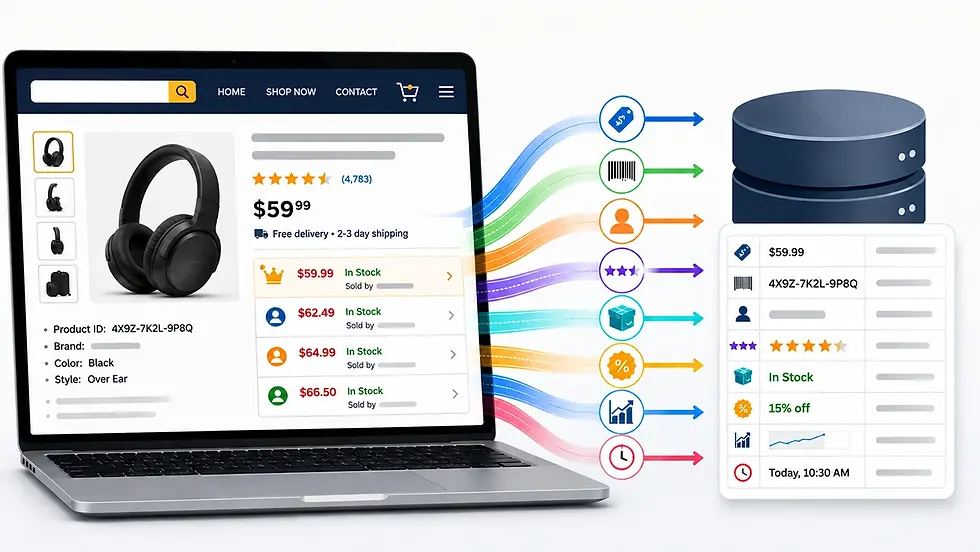
On platforms where multiple sellers offer the same tire, each seller may carry a different price, ranking, and stock status. Capturing that data accurately requires parsing each seller individually, not just pulling the displayed featured price.
Seasonal and event-driven demand
Holiday events like Black Friday, Labor Day, and Memorial Day drive significant temporary pricing shifts. A solution without on-demand surge collection capability will miss some of the most commercially important pricing windows of the year.
The ROI case for automated pricing intelligence
The financial case for investing in competitive pricing data is well-documented. McKinsey research, cited by Harvard Business Review, shows that a 1% price improvement translates to an 8.7% increase in operating profits, roughly three times more impactful than an equivalent improvement in sales volume.

Bain & Company analysis of B2B companies across a wide range of sectors found that companies earn an 8% increase in operating profit for every 1% of improvement in realized price, roughly twice the benefit of equivalent improvements in market share or cost reduction. Simon-Kucher & Partners research found that a 5% pricing improvement without volume loss can boost profits by 30% to 50%.
The contrast with manual methods is stark. Manual price checking consumes approximately 15 to 20 hours per week for a team monitoring just 100 products. A person can typically collect around 100 prices per hour, meaning that monitoring 50,000 tire SKUs across 20 competitors would require an impossibly large team working continuously.

Automated pricing intelligence delivers continuous coverage at a fraction of that cost, with accuracy rates manual methods cannot match.
Eight criteria for evaluating a tire pricing data solution
Not all pricing data solutions deliver equal value. Based on research and what we have observed across enterprise tire retail engagements, these are the criteria that separate adequate solutions from genuinely capable ones.
Criterion | What to Look For | Tire-Specific Requirement |
Accuracy | 99%+ verified accuracy with documented QA process | Normalized price-per-tire; correct separation of shipping and installation fees |
Coverage | 15 to 25+ competitor sites, 30,000 to 50,000+ SKUs | Regional pricing by ZIP code; multi-seller marketplace capture |
Update frequency | Weekly minimum with on-demand surge capability | Holiday and promotional crawls (Black Friday, Memorial Day, Labor Day) |
Technical depth | Add-to-cart extraction, CAPTCHA handling, JavaScript rendering | Login-required sites, multi-seller parsing, NLP product matching |
Data delivery | API, CSV, JSON, dashboard; ERP and POS integration ready | Timestamps, stock status, MAP compliance flags |
Scalability | Handle 50,000+ SKUs without proportional cost increases | Support for growing EV and SUV tire segment SKUs |
Compliance | Documented ethical scraping practices; public data only | MAP monitoring capability for manufacturer compliance |
Support model | Proactive site-change monitoring; dedicated team | Industry expertise in tire-specific data challenges |
Accuracy: the single most important criterion
A common finding in pricing intelligence audits is that data products contain "statistical smoothing and gap-plugging" rather than actual market prices. For tire retail, accuracy requirements go beyond simply matching the displayed number. They include normalized price-per-tire calculations (since some retailers price per pair or set of four), correct attribution of shipping costs by ZIP code, and proper separation of installation fees.
The industry benchmark for enterprise-grade accuracy is 99% or above, verified through regression testing and cached page storage for audit transparency. Our pricing data collection work with a major national tire retailer documented 99%+ accuracy across roughly 1 million pricing rows per weekly crawl, achieved through 50+ quality assurance checks per data file and automated anomaly detection that flags sudden implausible shifts, like an 80% price drop on a single SKU overnight. You can read the full breakdown in our tire retailer case study.
Technical depth: where most generic tools fail
The tire vertical's specific data challenges, particularly add-to-cart pricing extraction and multi-seller marketplace parsing, are not edge cases. They represent a significant portion of the competitive pricing data retailers actually need. Capable solutions use headless browsers, rotating residential proxies, session management for authenticated sites, and NLP-based parsing to normalize product descriptions across retailers. Solutions that cannot handle these requirements will deliver systematically incomplete data, often without making the gaps obvious.
Treating collection obstacles as engineering problems rather than inherent limitations, is what distinguishes serious data partners from tools that work until they don't.
Self-service tools vs. fully managed services
The pricing data market offers two fundamentally different approaches: self-service platforms that provide tools to build and maintain your own scrapers, and fully managed services where a dedicated team handles every aspect of collection and quality assurance.
Self-service platforms
Self-service platforms require in-house technical expertise to configure crawlers, manage proxy rotation, solve CAPTCHAs, handle site structure changes, and validate data quality. When a target website updates its layout, which happens constantly, self-service users must diagnose and fix the breakage themselves. In tire retail, where add-to-cart flows and checkout structures change regularly, that maintenance burden is significant.
Fully managed services
Fully managed services embed operationally into client workflows. When competitor sites deploy new CAPTCHA systems or change checkout flows, the provider's engineering team proactively updates crawlers to maintain uninterrupted data delivery with no action required from the client. The trade-off is cost and flexibility: managed services typically involve custom scoping and project-based pricing rather than flat subscription tiers.
For retailers monitoring 50,000+ SKUs across a competitive landscape with tire-specific technical complexity, the managed model typically holds the advantage. The maintenance overhead of self-service platforms compounds quickly at that scale, and a single silent data gap during a promotional period can undermine an entire repricing cycle.
Our managed web scraping service is built around this model. Jorge Diaz, Pricing Manager at Advance Auto Parts, described the practical impact:

How to run a pilot evaluation
Before committing to a data partner, run a structured pilot with a defined subset of SKUs. A well-scoped pilot gives you concrete evidence of accuracy and integration quality before you commit to full deployment.
A useful pilot for tire pricing covers the following:
Include at least three competitors with known technical complexity, particularly those with add-to-cart pricing or login-required content
Cover multiple geographic zones for the same SKU set to validate ZIP-code-level accuracy
Run the pilot for at least two to four weeks to capture the full data refresh cycle and allow for any initial setup adjustments
Manually spot-check a sample of returned prices against actual competitor websites during and after the pilot to verify accuracy
Request the data in your intended delivery format (CSV, JSON, API, direct database connection) to validate integration readiness before full deployment
Verify that the provider documents their QA process transparently, including what checks are applied to each data file and how anomalies are flagged and resolved. A partner who cannot explain their quality assurance methodology in specific terms is one worth being skeptical of.
Frequently asked questions
How often should tire pricing data be refreshed?
Weekly full-scale collection is the minimum for most competitive tire retail programs. Markets that change more rapidly, particularly during promotional periods or following manufacturer price announcements, benefit from the ability to run ad-hoc crawls outside the regular schedule. The 2025 tariff environment makes surge collection capability more valuable than it was even a year ago.
How do I know if pricing data is actually accurate?
Ask your provider for documentation on their QA process, specifically the number and type of checks applied per data file. Spot-check a sample of returned prices against the live competitor websites and request cached page storage so you can audit any data point against what was actually on the source site at collection time. Providers who cannot support that level of transparency should be a red flag.
What does enterprise tire pricing data collection cost?
Custom project-based pricing is standard for enterprise-grade managed services, with cost driven by the number of competitors, SKU volume, geographic zones, refresh frequency, and delivery requirements. Flat-subscription tools may appear cheaper but often lack the technical depth or QA rigor that tire retail specifically requires. Most credible providers, including Ficstar, offer a free trial to let you validate capability before committing.
What data formats and delivery methods should I expect?
At minimum, look for CSV, JSON, and API delivery. Enterprise-grade solutions should also support direct database integration, SFTP, and custom formats that map cleanly to your existing ERP or pricing management systems. The data itself should include timestamps, stock availability, MAP compliance flags, and shipping cost attribution, not just the top-line price.
Getting started
Choosing a tire pricing data solution is ultimately a decision about operational reliability. In an industry where a 1% pricing improvement can boost operating profit by 8% or more, the cost of inaction compounds quickly. The practical next step is defining the scope of competitive intelligence your program requires, then running a pilot with a qualified data partner to measure accuracy and integration quality before full deployment.
If you want to discuss your specific requirements, contact us at Ficstar for a free consultation. We have worked with tire retailers and automotive parts distributors for over a decade and can tell you honestly whether our approach is the right fit for your program.

Comments