
Best Compensation Benchmarking Data Providers in 2026

Updated: Jul 28

The best compensation benchmarking data provider depends on the kind of pay data you actually need. Traditional salary surveys like Mercer and Willis Towers Watson give you board-defensible benchmarks. Real-time platforms like Pave and Ravio keep numbers current. Aggregators like Salary.com pull from many datasets at once. And when you need pay data for specific roles, regions, or competitors that off-the-shelf reports miss, a fully managed data collection partner builds that dataset for you from public sources. At Ficstar, we have spent 20+ years collecting public web data for more than 200 enterprise customers, including the job posting and salary data that feeds custom compensation analysis.
Two HR teams can benchmark the same "Senior Software Engineer" role and land $30,000 apart, not because one used a better tool, but because each tool sits on a different pool of data. So the real question is not "which provider is best," it is "which data source matches the decision you are making." This guide breaks down the main categories, who each one fits, and roughly what they cost, so you can pick with confidence.

What compensation benchmarking data is and why the source matters
Compensation benchmarking uses market pay data to set competitive salaries, bonuses, and equity. The figure you get back is only as good as the data underneath it, and different providers build that data in very different ways.
There are five broad approaches:
Employer surveys, where companies submit their pay data and the provider aggregates it
Live platform data, pulled continuously from HR systems and job boards
Aggregated datasets, where one provider licenses and blends several sources
Crowdsourced data, self-reported by employees on public sites
Custom collection, where public job postings and salary ranges are gathered and structured for your exact roles and markets

Each approach trades off freshness, breadth, granularity, and cost differently. Most organizations end up blending a few of them rather than relying on one.
How to choose a pay data provider
Before comparing names, get clear on what matters for your decision. Five criteria separate a useful benchmark from a misleading one:
Freshness. How recently was the data collected? Annual surveys can be a year old by publication, which matters more for fast-moving roles than for stable ones.
Peer-group match. Benchmarking a Series B startup against a Fortune 500 rarely produces meaningful numbers. You want data from companies that look like yours in size, sector, and location.
Coverage of your roles and markets. Off-the-shelf reports cover common roles well and niche or emerging roles poorly. The further your roles sit from the mainstream, the harder they are to benchmark with standard products.
Methodology transparency. Can the provider tell you where the numbers came from and how they were validated? Opaque blends are hard to defend in a pay review.
Cost and cadence. Free sources cost nothing but verify little. Enterprise surveys are thorough but expensive. Match the spend to how often you actually act on the data.
Compensation data providers compared at a glance
Provider type | Examples | How the data is gathered | Best for | Typical cost |
Custom data collection | Ficstar | Public job postings, salary ranges, and career pages, collected and structured for you | Role, region, or competitor pay data that off-the-shelf reports miss | Custom quote |
Traditional salary surveys | Mercer, Willis Towers Watson, Aon, Korn Ferry | Employer-submitted data, published on an annual cycle | Board-defensible benchmarks across pay, bonus, and equity | Enterprise license, often five figures per year |
Real-time platforms | Pave, Ravio, Carta | Live HRIS connections and job board data | Fast-moving roles and equity at growth-stage companies | Subscription |
Aggregators | Salary.com, ERI | Several licensed datasets blended together | Formalizing salary bands and structures | Subscription |
Crowdsourced and free | Glassdoor, Levels.fyi | Self-reported by employees | Quick, directional sanity checks | Free |
Government data | BLS, O*NET | National wage surveys | High-level benchmarks and compliance | Free |

Custom data collection for role and region-specific pay data
The biggest blind spot in compensation benchmarking is the role or market your survey does not cover. A new specialty, a niche geography, a specific named competitor, an emerging skill set. Standard products report on what is common, and they report it on a publishing schedule. When you need pay data outside those lines, custom collection fills the gap.
The approach is straightforward. A managed partner identifies the public sources that carry the pay signal you care about, such as job boards, company career pages, and regional listing sites, then collects, cleans, deduplicates, and delivers the data in the format your team uses. You define the roles, the markets, and the cadence, and the dataset is built around that rather than around what a survey panel happened to submit.
This is where our work fits. At Ficstar, we treat this as a fully managed service. Our team handles the collection, normalizes inconsistent fields across sites, removes duplicate postings, and delivers clean output on the schedule you choose. We pull job listings and salary data from major boards, niche industry sites, and direct career pages, then standardize titles, locations, and disclosed compensation into one consistent structure. Every complex project runs through more than 50 quality checks before delivery, so the data arrives ready to analyze rather than ready to clean.
Custom collection is the strongest fit when your roles, markets, or competitor set are too specific for a packaged report, when you need data refreshed more often than an annual cycle allows, or when you want a defensible, source-traceable dataset you control. It is a premium option, priced per project rather than per seat, and it suits enterprises whose pay decisions justify purpose-built data. You can see how custom projects are scoped and what custom data collection costs in our pricing guide.
Traditional salary survey providers
Long-established providers run the surveys most large organizations still anchor to. Mercer, Willis Towers Watson, Aon, and Korn Ferry collect pay data directly from participating employers and publish validated benchmarks across base pay, bonuses, equity, and benefits, usually on an annual cycle.
Their strength is credibility. These datasets are deep, cover many industries and regions, and carry the kind of methodology a compensation committee will accept without argument. Aon reports that its Radford technology surveys draw on thousands of participating firms, and Korn Ferry and Willis Towers Watson run global panels spanning many countries.
The tradeoffs are freshness and fit. Because data is submitted manually and aggregated over months, a published figure can be close to a year old, which matters most for fast-moving or scarce roles. Surveys also tend to skew toward larger enterprises, so smaller or younger companies may not find a clean peer group. These providers fit best when you need formal, defensible benchmarks at scale and can absorb the cost and the cadence.
Real-time compensation platforms
A newer category keeps benchmarks current by pulling data continuously rather than once a year. Platforms such as Pave, Ravio, and Carta Total Comp connect to participating companies' HR systems and supplement that with job board data, so the numbers reflect what the market is paying now.
The appeal is freshness and equity detail. For startups and high-growth tech companies competing for scarce talent, a benchmark that updates in near real time is worth more than one that is six months stale, and these platforms tend to handle equity and variable pay well. Ravio is especially rich in European tech markets, while Carta's data leans toward venture-backed companies already on its cap-table platform.
The limit is coverage. Live platforms are strongest where their customer base is dense, usually North American and European technology firms, and thinner outside it. They fit fast-moving companies that value current data over the broad, validated panels that surveys provide.
Aggregator platforms for building salary structures
Aggregators license several underlying datasets and blend them into one product. Salary.com's CompAnalyst and ERI combine employer surveys, user-submitted data, and in some cases government statistics, then layer job-matching tools and structured pay libraries on top.
The advantage is breadth and usability. Broad coverage plus filtering and structure tools make aggregators a practical choice for HR teams formalizing salary bands across many roles at once. The catch is that freshness and methodology vary by underlying source, and the blend can be harder to interrogate than a single survey. Aggregators fit mid-market firms standardizing pay structures who want wide coverage and built-in tooling more than they need a single, fully transparent methodology.
Free and government pay data sources
Not every benchmark needs a paid product. Crowdsourced sites like Glassdoor and Levels.fyi offer quick salary figures, and they are easy to reach. The catch is that the data is self-reported with limited verification, so it works for a directional sanity check but rarely for senior roles or regulated pay decisions.
Government data is the other free option, and it is authoritative. The U.S. Bureau of Labor Statistics publishes wage estimates for roughly 830 occupations through its Occupational Employment and Wage Statistics program, updated once a year. The data is solid for high-level budgeting and compliance, but it is highly aggregated and lacks the company-level granularity most pay decisions need. Free sources work best as a baseline or a cross-check, not as the sole basis for setting pay.
What's changing for compensation data in 2026
Two forces are raising the bar on data quality this year. Pay transparency rules are tightening, and remote hiring keeps reshaping which markets actually compete for the same role.
The clearest example is the EU Pay Transparency Directive. According to the European Commission, member states face a transposition deadline of 7 June 2026 to bring the directive into national law, which pushes employers toward defensible, current, well-documented pay data rather than rough estimates. When you may have to explain a pay gap, the source of your benchmark matters as much as the number.
The practical effect is that freshness and traceability are becoming requirements, not nice-to-haves. That favors sources you can keep current and document, whether that is a real-time platform for covered roles or custom collection for the roles those platforms miss.
How often should compensation data be updated?
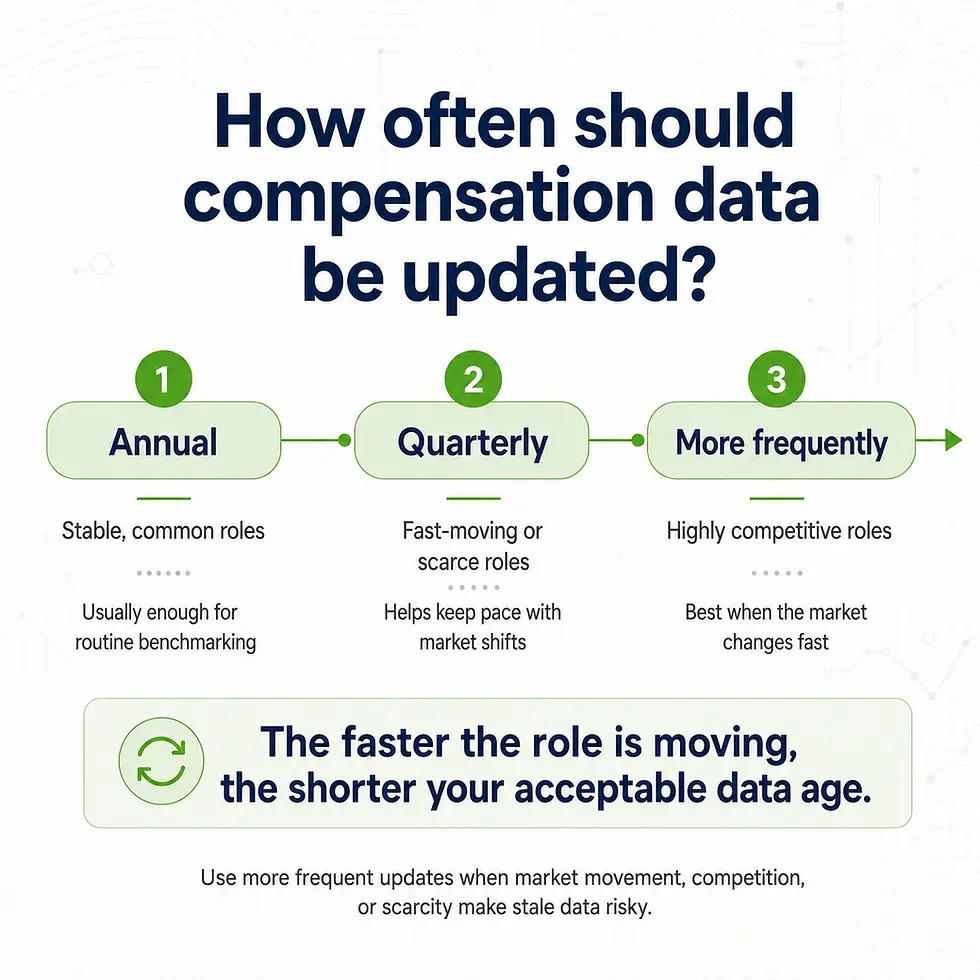
For stable, common roles, an annual refresh is usually enough. For fast-moving, scarce, or competitive roles, quarterly or more frequent updates keep you from anchoring to a stale market. The faster the role is moving, the shorter your acceptable data age.
Is free salary data reliable enough for benchmarking?
Free crowdsourced data is fine for a quick directional read, but its self-reported nature and limited verification make it weak for senior roles or regulated pay decisions. Use it to sanity-check a paid benchmark, not to replace one.
Is it legal to collect salary data from job postings?
Collecting pay data that is publicly posted, such as salary ranges in job listings, is generally permissible when you respect each site's terms and applicable privacy law. The complexity sits in doing it cleanly and compliantly at scale, which is one reason a managed approach helps. At Ficstar, we collect only publicly available data, respect site policies, and maintain practices aligned with GDPR and CCPA, so the dataset is defensible as well as useful.
How much does compensation benchmarking data cost?
It ranges widely by approach. Crowdsourced and government data are free. Enterprise survey licenses commonly run into five figures per year. Real-time platforms and aggregators are typically subscription-based. Custom collection is quoted per project, scoped to your roles, sources, and cadence, which is why providers price it individually rather than off a flat plan.
Matching the provider to your compensation strategy
No single source covers every need. Large global firms often anchor to Mercer or Willis Towers Watson for depth, growth-stage tech companies lean on real-time platforms for current data, and most teams cross-check against free sources. The gaps that remain, the specific roles, markets, and competitors your packaged reports do not reach, are where custom collection earns its place.
If those gaps are where your pay decisions get hard, we can build a compensation dataset around your exact roles and markets and prove the quality before you commit. Start Your Free Trial and we will show you what your data looks like.


Comments